


 Français
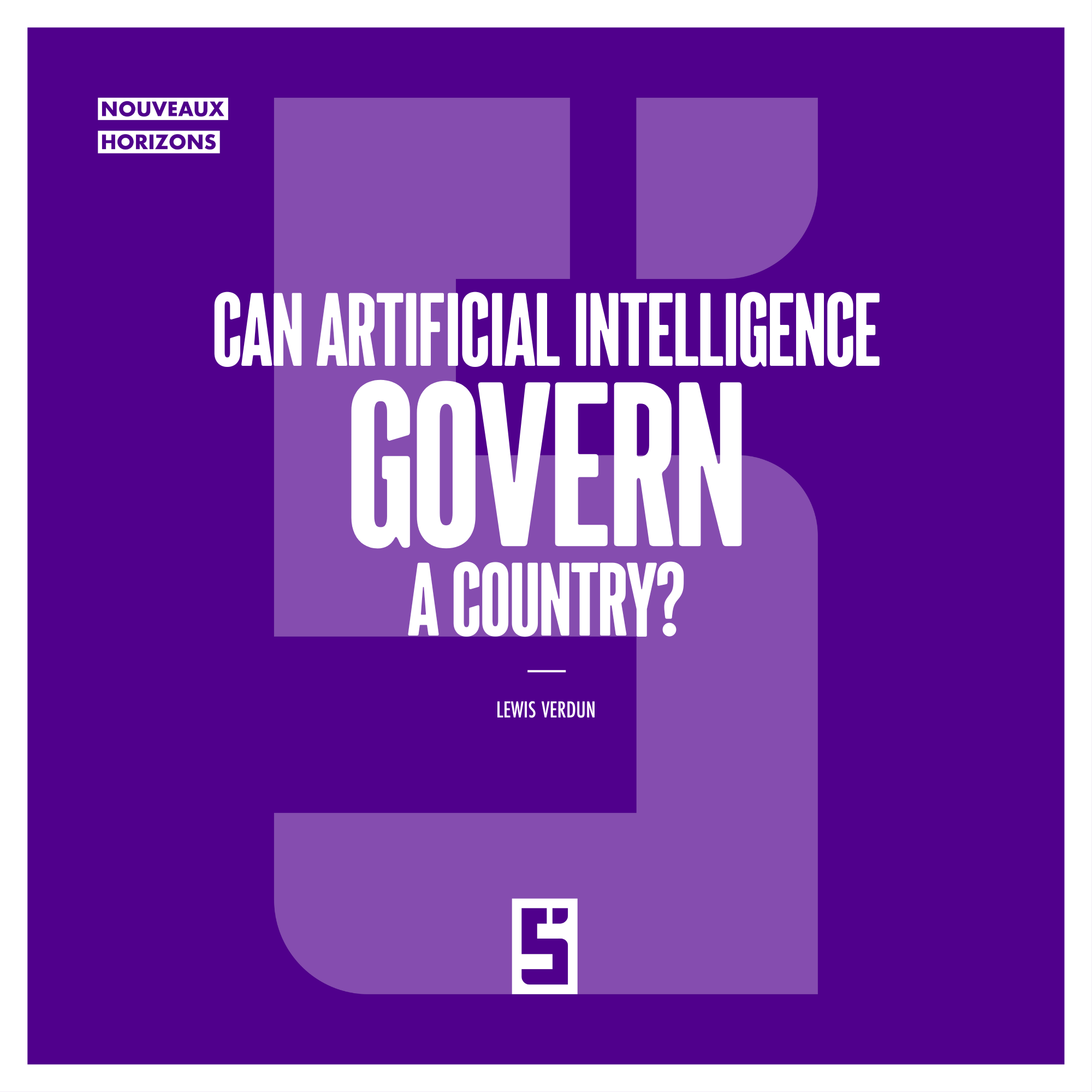
 Artificial intelligence continues to reshape our societies. After transforming industry, finance, and healthcare, it is now entering the political arena. Governing a country through algorithms—science fiction or an emerging reality? This provocative question is explored in the essay Can Artificial Intelligence Govern a Country? by Léwis Verdun, prompting us to reflect on the role that technology could—or should—play in public administration.
Rather than analyzing the book directly, we’ll explore a related but essential topic: the place of technology in democratic systems. Can it enhance transparency, citizen participation, and government efficiency? Or does it risk undermining the very foundations of democracy? Let’s dive into this timely and thought-provoking issue.
Technology and democracy: a conditional alliance
Since the rise of e-government, states have gradually adopted digital tools to improve efficiency: online tax management, citizen participation platforms, electronic voting systems… But as AI advances, a new stage is emerging—the partial automation of decision-making processes.
The promise is attractive: algorithms capable of analyzing vast datasets to predict needs, prevent crises, and optimize resource allocation. Estonia, a digital pioneer, has implemented virtual assistants to guide citizens through administrative tasks. In South Korea, predictive tools anticipate traffic jams or pollution spikes.
Yet this algorithmic efficiency raises a critical question: can we entrust public decisions to unelected systems, often opaque and developed by private companies?
The ethical and technical limits of algorithmic governance
Governance automation does not come without risks. Algorithmic bias, well-documented in predictive justice or automated recruitment, can lead to large-scale injustices. The Dutch childcare benefits scandal—where an algorithm systematically discriminated against certain populations—highlights the danger of poorly regulated systems.
Other challenges are technical: lack of decision explainability, dependence on available data, and the difficulty of incorporating human values like empathy, social justice, or political nuance.
Without safeguards, AI could lead to dehumanized governance models, driven by efficiency or profit, at the expense of fundamental rights. In essence, a form of automated technocracy incompatible with democratic principles.
Augmented democracy: a vision between innovation and caution
Rather than fantasizing about a sovereign AI, a more constructive perspective is that of augmented democracy—a model where AI serves as a decision-support tool, not an autonomous authority.
This vision is shared by many experts in public policy and tech ethics. It assumes that AI can be used to:
facilitate the analysis of complex data to inform public policies
detect weak signals (social unrest, emerging health crises)
automate administrative tasks to free up time for human agents
But for this to work, three essential conditions must be met:
Transparency of algorithms
Continuous human oversight
Protection of citizens' rights, particularly privacy and non-discrimination
Toward responsible digital governance: best practices and real-world initiatives
In response to these challenges, several countries and institutions are beginning to establish legal frameworks. The EU AI Act, for instance, strictly regulates AI use in sensitive sectors such as public governance. In the U.S., a presidential executive order requires system audits before deployment. China, meanwhile, closely monitors AI use in media and government.
Here are some best practices for ethical digital governance:
Do:
Define AI as a decision-making assistant, not an autonomous authority
Train public officials in the use and limitations of technology
Establish independent ethics committees to assess risks
Engage citizens in debates on automation and technology adoption
Avoid:
Launching experiments without a legal framework
Outsourcing public decision-making entirely to private vendors
Using AI to monitor the population without democratic checks and balances
Can digital tools strengthen citizen participation?
One often overlooked aspect of technology is its potential to revitalize participatory democracy. Online consultations, digital participatory budgeting, AI-assisted deliberative forums—these tools can give citizens a voice and encourage ongoing dialogue with policymakers.
Some European cities are experimenting with models where AI helps synthesize citizen feedback, giving elected officials a clear view of public opinion. This doesn’t replace political debate, but it can enrich it.
However, inclusiveness remains a challenge. The most vulnerable populations often have the least access to digital tools. It is therefore crucial to balance technological innovation with social justice to prevent AI from widening democratic divides.
What if AI could illuminate democracy without ruling it?
The book Can Artificial Intelligence Govern a Country? by Léwis Verdun tackles these questions with rigor, clarity, and critical insight. Avoiding both alarmism and blind enthusiasm, it offers a comprehensive overview of the advances, limitations, and stakes involved in automated governance. It advocates for an AI that serves the public good, under democratic control and respectful of fundamental rights.
For those seeking to understand how our institutions might evolve in the digital age, this concise and accessible essay is essential reading.
Discover Can Artificial Intelligence Govern a Country? now on FIVE MINUTES!