


 Français
 Our daily lives rely heavily on intuition. Toss a coin, and it feels natural to assume a 50/50 chance of heads. If two people are in a room, the odds of them sharing a birthday seem negligible. Yet mathematics often proves that our natural logic is flawed—even deceptive. This gap between intuition and reality is precisely where paradoxes thrive.
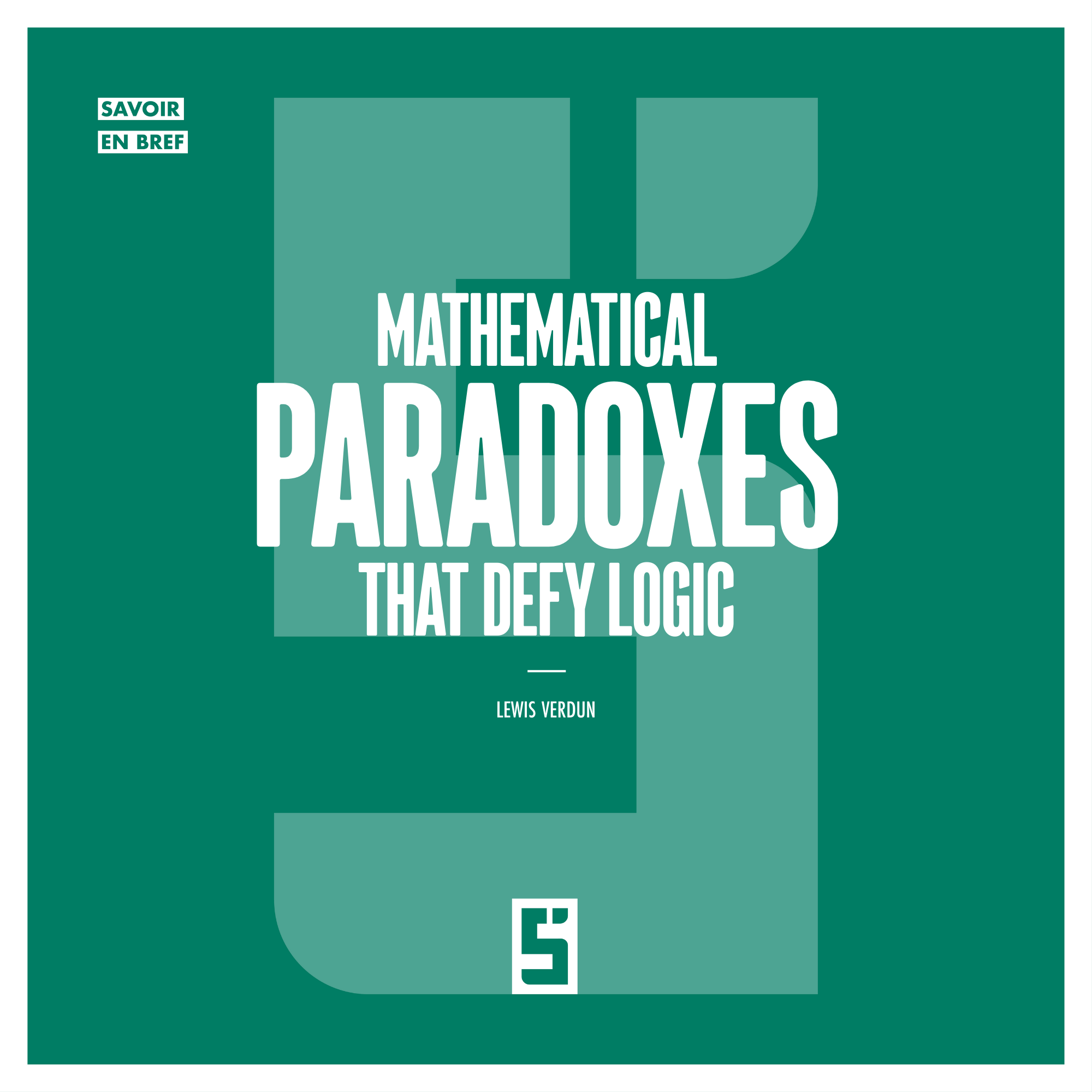
In Mathematical Paradoxes That Defy Logic by Léwis Verdun (Five Minutes Editions), we dive into a fascinating world where pure logic challenges our most firmly held beliefs. Rather than directly summarizing the book’s content, let’s explore a related theme: misleading intuition in decision-making, whether in mathematics, economics, or everyday life. This is a powerful lens for understanding why paradoxes are more than brainteasers—they are truth-revealing tools.
When the Brain Simplifies… and Misleads
Our brains love shortcuts. When faced with complex situations, they rely on heuristics—mental rules of thumb for fast decision-making. Sometimes this works. But often, it leads us astray.
Consider the well-known Birthday Paradox. It seems unlikely that in a group of 23 people, two would share the same birthday. Yet, statistically, the probability exceeds 50%. This counterintuitive result shows how we underestimate the number of possible pairings in a group.
The phenomenon extends beyond probabilities. In economics, Jevons Paradox reveals that the more efficient a technology becomes, the more total consumption increases—defying environmental intuition. Similarly, voting paradoxes demonstrate how majority voting can lead to contradictory or even reversed outcomes, going against collective preference.
These scenarios aren’t just curiosities. They highlight the ongoing tension between intuitive reasoning and formal analysis. Recognizing this tension is a first step into the world Léwis Verdun so clearly illustrates.
Paradoxes and Cognitive Biases: Two Sides of the Same Coin
Why are we so quick to accept false conclusions? Cognitive biases are a big part of the answer. Our brains favor simplicity, overestimate visible patterns, and ignore unlikely probabilities.
The Parrondo Paradox perfectly captures this: two losing games, when alternated strategically, can result in a winning outcome. At first glance, this seems absurd. But mathematically, it's solid. This touches on well-known biases, such as linear thinking, which leads us to believe that a string of losses will always yield a net loss.
In a different vein, the Friendship Paradox reveals that most of our friends have more friends than we do. It’s a simple structural effect in social networks, but it challenges our intuitive understanding of averages.
Paradoxes serve as magnifying glasses for these mental errors. Studying them sharpens our reasoning, helps us separate impression from proof, and teaches us to question faulty mental shortcuts.
Real-World Implications in AI and Social Sciences
Léwis Verdun’s book also explores how paradoxes pose limits to artificial intelligence, through logical dilemmas inherited from Gödel and Turing. These are not abstract puzzles—they shape what machines can learn, infer, and decide.
Take the Liar Paradox (“This sentence is false”). If true, it’s false—and vice versa. This type of self-reference has deep consequences in natural language processing systems, where AI must handle ambiguous, contradictory, or context-dependent statements.
In the social sciences, paradoxes like strategic voting or perverse incentives show that human behavior often defies seemingly logical systems. For example, offering performance bonuses can reduce team efficiency if it undermines collaboration.
In all these cases, paradoxes aren’t bugs in the system—they are windows into the complexity of reality. They compel us to think differently.
Practical Tools: Learning to Think “Counterintuitively”
Studying paradoxes is a way of unlearning. Here are some practical approaches to cultivating paradox-based thinking:
Questions to ask when faced with a logical claim:
Am I relying on intuition or data?
Have I considered all possible alternatives?
Does the reasoning shift if I change scale (e.g., individual vs. population)?
List of real-life examples to experiment with:
Try the Birthday Paradox in a group
Simulate a voting strategy (Condorcet vs. majority rule)
Recreate Parrondo’s Paradox using tokens and two biased games
These experiences provide a firsthand encounter with the revealing power of paradoxes and help develop critical, unconventional thinking.
Paradoxes aren’t mere puzzles for mathematicians or philosophers—they are powerful intellectual tools. They destabilize to enlighten, confuse to clarify, and challenge our minds to grow. This is precisely what Léwis Verdun captures in Mathematical Paradoxes That Defy Logic.
Whether you’re a science enthusiast, a critical thinker, or simply curious about surprising ideas, this book offers a rigorous yet accessible journey into some of the most subtle aspects of human reasoning.
Discover Mathematical Paradoxes That Defy Logic now on Five Minutes!