


 Français
 Writing seems so natural today that we easily forget just how profoundly this invention transformed human history. A few signs traced on a clay tablet, a sheet of paper, or a screen allow us to preserve an idea, pass on knowledge, and communicate with someone on the other side of the world. But writing does more than simply record information: it also influences the way we think.
The relationship between writing and the brain is particularly fascinating at a time when an increasing share of our communication takes place through keyboards, smartphones, and now generative artificial intelligence tools. When we write, we have to select information, organize our ideas, and transform thoughts that may still be imprecise into understandable language.
This ability is part of a much broader history. From the earliest writing systems to today’s digital environments, every evolution in writing technology has changed our relationship with knowledge.
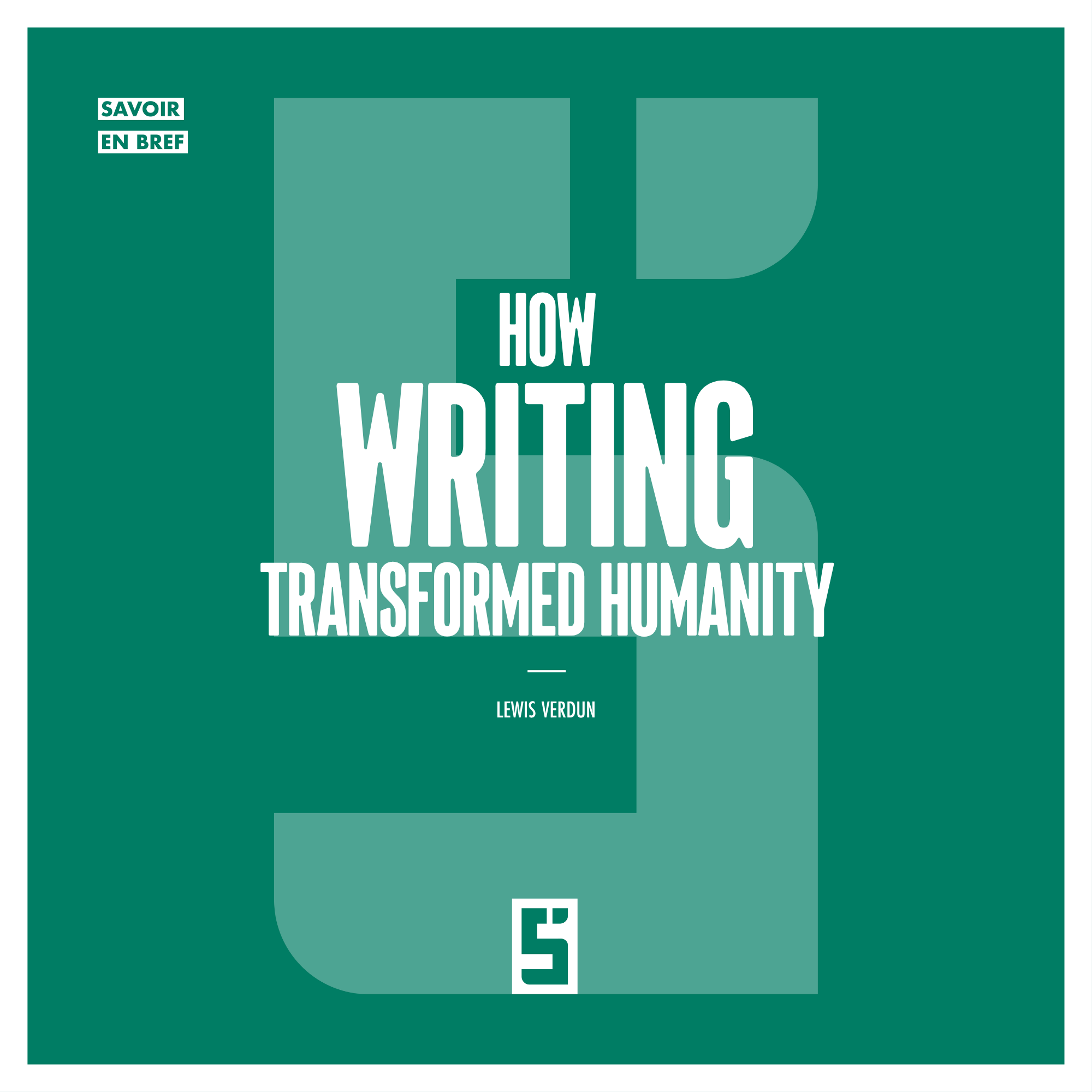
This is precisely the transformation Léwis Verdun explores in How Writing Transformed Humanity, published in Five Minutes’ KNOWLEDGE IN BRIEF collection. Without revealing the contents of the book, one question deserves closer examination: what actually happens when we write, and why does this activity remain essential in a world dominated by screens and artificial intelligence?
Writing Is More Than Simply Recording Our Thoughts
We tend to imagine thought as something that comes before writing: first, we have a perfectly formed idea in our minds, and then we put it down on paper.
In reality, the process is often much more complex.
Writing forces us to give structure to what was previously unclear or diffuse. To explain an idea, we have to choose the right words, determine the order of our arguments, establish relationships between different pieces of information, and eliminate contradictions.
Writing therefore becomes a tool for reflection.
Take a simple example. Someone faced with a difficult decision may spend several hours thinking about it without making any real progress. If that person writes down the different possibilities, their advantages, their risks, and their consequences, the situation often becomes clearer.
The problem itself has not necessarily changed. Its representation has.
This mechanism helps explain why writing is present in so many areas: learning, scientific research, project management, literary creation, personal journaling, and strategic thinking.
Writing offers something that thought alone does not always provide: an external space in which our ideas can be observed, compared, and reorganized.
Human history can also be viewed from this perspective. The emergence of writing systems allowed societies to preserve information beyond the limits of individual memory. Laws, commercial transactions, stories, scientific knowledge, and traditions could gradually be transmitted over long periods of time.
Writing therefore became a form of external memory for humanity.
Handwriting, Memory, and Learning: Why the Physical Act Matters
The proliferation of digital devices has profoundly changed our habits. Many of us can go through an entire day without writing more than a few words by hand.
Yet scientific research continues to investigate the differences between handwriting, memory, and learning.
Writing by hand involves complex coordination between visual perception, fine motor movements, and language processing. It is also generally slower than typing on a keyboard.
This apparent slowness can be an advantage because it often forces us to select information.
When students take handwritten notes, for example, they cannot always transcribe every sentence they hear. They must identify the important elements, reformulate them, and organize them. In other words, they actively process the information.
Recent scientific studies have observed differences in brain activity and connectivity associated with handwriting and keyboard typing. This research is helping us better understand the connections between the physical act of writing, memory, and learning mechanisms.
This obviously does not mean that we should abandon computers. Keyboards offer considerable advantages when it comes to writing quickly, making corrections, conducting research, or sharing documents.
The relevant question is therefore probably not “paper or screen?” but rather: which tool should we use depending on what we want to achieve?
For memorizing a concept, developing an initial idea, or thinking through a problem, handwriting can be particularly valuable. For restructuring a long text, collaborating with others, or distributing information, digital tools are often more efficient.
Mastering writing in the modern world therefore also means knowing how to alternate intelligently between different mediums.
The Benefits of Writing Go Far Beyond Learning
The benefits of writing are not limited to education or memorization. For several decades, researchers have also studied what is known as expressive writing: putting experiences, emotions, or significant events into words.
Why might writing about what we feel be useful?
One possible explanation once again involves structure.
A difficult experience can remain in our minds as a collection of fragmented emotions, images, and thoughts. Turning it into a narrative requires us to give it an order: What happened? What did I feel? Why is this event important? What can I understand about it today?
Writing therefore creates a certain distance between the experience and the person observing it.
It is obviously not a substitute for medical or psychological care when such support is necessary. However, it can be used as a complementary tool for personal reflection.
This practice does not require any literary talent. The objective is not to produce a text intended for publication, but to transform thoughts into words.
A notebook can therefore become a genuine personal laboratory.
We can use it to examine a decision, monitor the development of a project, record an idea, summarize what we have just learned, or simply try to understand a situation.
At a time when we continuously consume content produced by others, writing offers another important benefit: it puts us back into an active position.
Reading, watching, or listening provides us with information. Writing forces us to create meaning.
Artificial Intelligence and Writing: A New Transformation
The arrival of generative artificial intelligence marks a major development in this long history.
For the first time, tools available to the general public can instantly generate sophisticated texts, reformulate arguments, summarize documents, or suggest ideas.
Does this mean that knowing how to write is becoming less important?
Probably the opposite.
The more capable machines become at producing text, the more humans need to know how to evaluate that text.
Using artificial intelligence effectively requires the ability to formulate a precise request, recognize a superficial answer, verify information, detect inconsistencies, and modify a text so that it genuinely reflects the intended meaning.
The relationship between artificial intelligence and writing therefore raises a fundamental question: do we want to use technology to replace our thinking or to enhance it?
An AI tool can accelerate certain stages of the writing process. But systematically delegating the entire process may also eliminate some of the intellectual effort that gives writing its value in the first place.
Searching for the right wording, constructing an argument, or reorganizing a paragraph is not simply an inconvenience standing between us and the final result. That effort is part of the thinking process itself.
The challenge therefore becomes one of digital literacy: knowing how to read, write, research, verify, and produce information in environments where human-created and automatically generated content increasingly coexist.
Writing is not disappearing. It is changing form once again.
How Can We Bring More Writing Into Our Daily Lives?
There is no need to write several pages every day to benefit from the effects of writing on reflection and learning. A few simple practices can help us develop a more active relationship with the written word.
For example, you can:
- summarize by hand what you have just learned to help you remember it;
- write down the different options before making an important decision;
- spend a few minutes freewriting to develop an idea;
- keep a journal regularly to gain perspective on your experiences;
- write down several possible solutions to the same problem;
- draft your initial ideas yourself before asking an artificial intelligence tool to analyze or expand on them.
Another particularly effective habit is to create a summary from memory.
After reading an article, listening to a lecture, or studying a chapter, close the source and write down what you remember. Then compare your summary with the original content.
This method immediately reveals the difference between recognizing information and actually being able to recall it.
It is also possible to combine paper and digital tools. An initial reflection can be developed by hand and then structured on a computer. Artificial intelligence can subsequently be used to suggest objections, identify unclear areas, or propose additional avenues to explore.
In this scenario, technology does not replace thought: it becomes an additional intellectual partner.
This distinction could become increasingly important in the years ahead.
For thousands of years, writing has accompanied the major transformations of human societies. It has enabled us to preserve knowledge, organize institutions, transmit discoveries, and circulate ideas across generations.
Today, a new chapter is beginning.
We can write on paper, dictate a message to a smartphone, or ask an artificial intelligence system to produce several pages in a matter of seconds. Yet behind these technological changes remains a profoundly human ability: the capacity to transform thought into language and to use language to examine that thought.
Preserving writing does not mean rejecting innovation. Rather, it means learning to combine handwriting, digital tools, and artificial intelligence intelligently without abandoning the reflective effort that gives writing its true value.
To place this evolution within a broader historical perspective, from the earliest writing civilizations to the challenges posed by generative AI, Léwis Verdun’s book offers a concise and accessible overview that invites us to look differently at this everyday tool whose influence on humanity has been immense.
Discover How Writing Transformed Humanity by Léwis Verdun now from FIVE MINUTES and explore in less than ten minutes how writing has shaped our past and could continue to transform our future.