


 Français
 A language does more than translate thoughts into words. It also provides a way to organize reality, transmit knowledge, tell a shared history, and maintain connections between generations. When a language is no longer spoken, its disappearance therefore extends far beyond the field of linguistics.
Today, a significant part of the world’s linguistic diversity is under threat. This situation has mobilized international institutions, researchers, and communities seeking to preserve and transmit languages that have become vulnerable.
Why do some languages become endangered? What do we lose when they disappear? And, perhaps most importantly, how can a community reverse this process?
These questions go far beyond simply identifying endangered languages. They challenge us to consider our relationship with cultural heritage, education, technology, and the diversity of human knowledge.
A Language Is Also a Way of Organizing the World
We tend to think of languages as different systems for expressing roughly the same things. Yet every language has developed within a particular historical, social, and geographical context.
Its vocabulary carries traces of that history.
Words used to describe plants, animals, landscapes, family relationships, or social practices can preserve knowledge accumulated over generations. Some terms do not even have a perfectly equivalent expression in another language.
Linguistic diversity can therefore be understood as a form of collective memory.
In some communities, part of the knowledge associated with the environment is primarily transmitted orally: the properties of certain plants, seasonal cycles, agricultural techniques, fishing practices, or an understanding of local ecosystems. A language can become the primary vehicle for preserving and transmitting this knowledge.
Its disappearance does not, of course, mean that all the knowledge held by its speakers instantly vanishes. Knowledge can be translated, recorded, or passed on in other ways. However, certain nuances, cultural associations, and categories that are specific to a language may become much more difficult to preserve.
This is what makes language extinction particularly significant: it can also weaken entire systems of knowledge.
Why Does a Language Stop Being Passed On?
A language rarely disappears because all its speakers collectively decide that it is no longer useful. The process generally results from a combination of social transformations.
One of the decisive moments occurs when parents stop passing their language on to their children.
This interruption may be linked to education, employment opportunities, migration, urbanization, or the social prestige associated with a dominant language. In certain historical contexts, it has also been encouraged by assimilation policies and the marginalization of particular populations.
Families may consequently favor a language they believe will offer their children greater opportunities in the future.
From an individual perspective, such a choice may appear entirely rational. But when the same decision is repeated across a large part of a community, the local language gradually loses its youngest speakers.
A generational pattern may then emerge: older people speak the language fluently, adults understand it but use it less frequently, while children primarily communicate in another language.
At this stage, a language may still have many people who understand it while already being seriously threatened.
The number of speakers is therefore not the only relevant indicator. Intergenerational transmission plays a crucial role.
When the Digital World Increases Linguistic Inequality
Language preservation now faces another major challenge: representation in the digital world.
Search engines, voice assistants, video platforms, translation software, online education systems, and artificial intelligence all depend on enormous quantities of data. Yet languages do not have equal access to digital resources.
Languages that are widely used online generally benefit from extensive written corpora, electronic dictionaries, audiovisual content, and large quantities of digitally available conversations.
A language spoken by a small community, by contrast, may have very little digitized material.
This difference directly affects the development of language technologies.
An artificial intelligence system trained on very little data in a particular language will generally have greater difficulty understanding and generating it correctly. A language that is already socially marginalized may therefore become marginalized within the digital tools people use every day as well.
A problematic cycle can emerge: limited content results in fewer digital tools, while the lack of suitable tools encourages speakers to use languages that are already better represented online.
Technology, however, can also work in the opposite direction.
Audio archives, digital dictionaries, educational applications, and community-created language corpora can support learning and transmission. The challenge is therefore not simply to choose between technology and linguistic diversity, but to determine which languages benefit from these technologies and how communities can participate in their development.
Can an Endangered Language Really Be Revived?
Language decline is not necessarily irreversible as long as speakers, archives, or a community committed to transmitting the language still exist.
This is the purpose of language revitalization.
The most ambitious initiatives generally go beyond producing a dictionary or recording the remaining speakers. They seek to restore the language to everyday life.
This can involve education, media, cultural activities, local government, artistic creation, or communication within families.
The principle is fundamental: a language remains alive when people use it.
Programs aimed at young children can, for example, help rebuild a process of transmission that had previously been interrupted. Adults may also learn the language of their grandparents before passing it on to their own children.
The Internet provides additional possibilities. A geographically dispersed community can now create online courses, record stories, publish videos, or develop archives that younger generations can access wherever they live.
Language revitalization then becomes a collective project rather than simply an exercise in conservation.
How Can We Help Preserve Linguistic Diversity?
You do not have to be a linguist to contribute to the recognition and preservation of threatened languages. Several practices can help create an environment that supports their transmission.
Family transmission is one of the most important tools. When a language is naturally spoken with children, it maintains an everyday function and continues to circulate from one generation to the next.
Recording speakers can also preserve stories, songs, expressions, and knowledge that might otherwise disappear. Such archives become especially valuable when they remain accessible to the communities concerned.
Creating digital content is another important approach. Podcasts, videos, written content, applications, and educational materials allow a language to exist in the spaces used by younger generations.
Bilingual education can also contribute to transmission by allowing students to learn through their own language while acquiring other languages that may be necessary for their education and future careers.
Finally, creating dictionaries, digital corpora, literary works, songs, and cultural content helps keep a language connected to contemporary life.
One principle, however, deserves particular attention: documenting a language does not automatically mean saving it.
A collection of recordings may allow researchers and future generations to study a language long after its last speakers have disappeared. But a truly living language needs people who communicate with one another through it.
Preservation should therefore ideally combine documentation, learning, and transmission.
Preserving Languages Also Means Preserving Knowledge
The issue of endangered languages ultimately reveals a broader reality: humanity possesses many different ways of understanding, describing, and organizing its environment.
Preserving this diversity does not mean attempting to freeze communities in the past. A language can evolve, borrow words, embrace contemporary technologies, and invent new expressions. All living languages change alongside the people who use them.
The goal is instead to enable communities to choose what they wish to transmit.
This distinction matters. A language preserved solely as an archival object no longer serves the same function as a language used to joke, work, learn, write, create, or speak to one’s children.
This is precisely what makes language revitalization a contemporary issue rather than merely an attempt to preserve the past.
The question then becomes particularly thought-provoking: how many different ways of thinking, describing, and transmitting the world do we want to preserve for future generations?
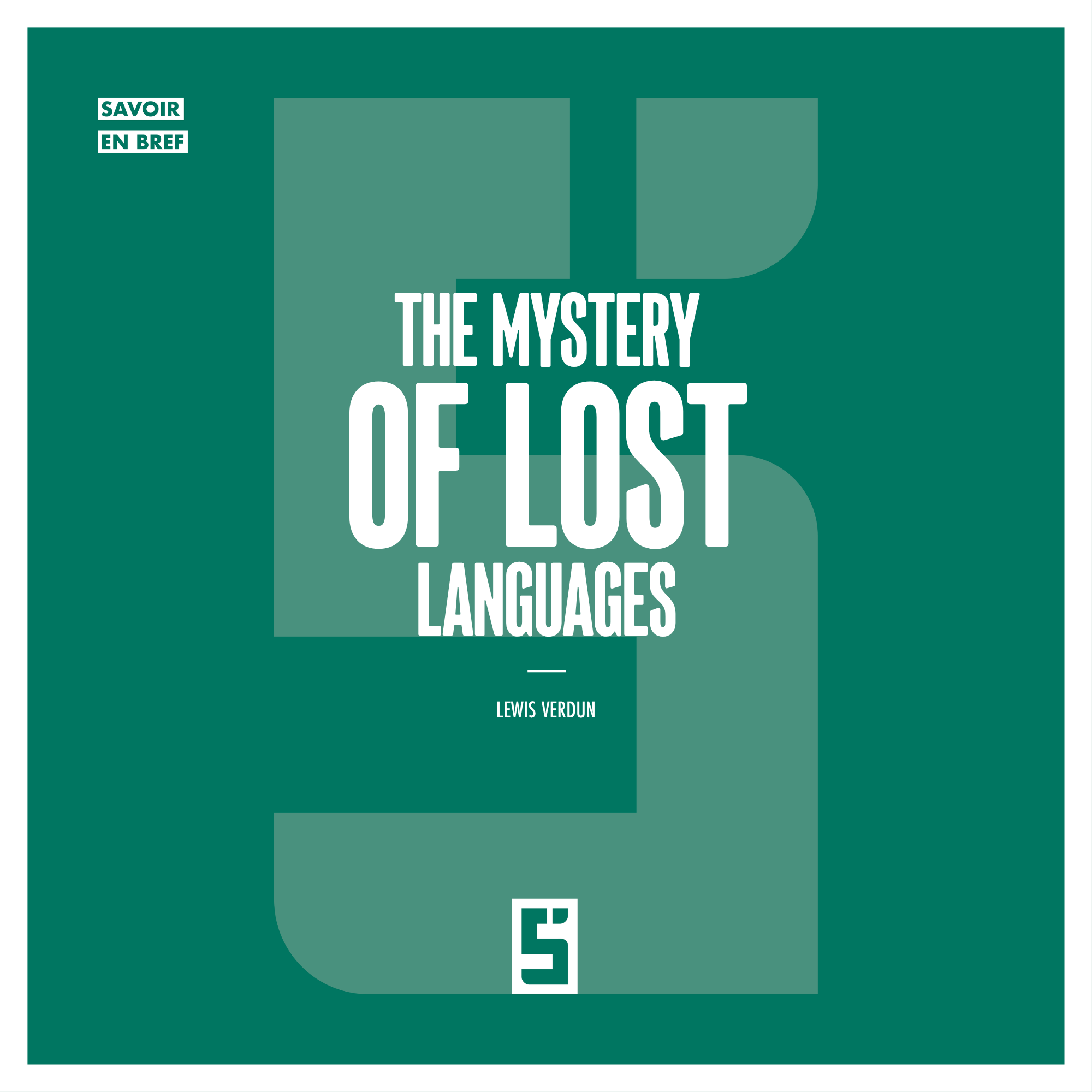
This is the broader reflection explored in The Mystery of Vanished Languages by Léwis Verdun. The book examines the mechanisms currently threatening thousands of languages, from the breakdown of family transmission and urbanization to migration, digital marginalization, and the emerging challenges associated with artificial intelligence.
Accessible and well documented, it invites readers to consider linguistic diversity not only as a heritage worth protecting, but also as a valuable resource for our collective future.
Discover The Mystery of Lost Languages by Léwis Verdun now on FIVE MINUTES and explore the hidden issues behind the disappearance of languages.