


 Français
What if the solutions to our greatest environmental and technological challenges were already present in nature? For millions of years, living organisms have developed strategies to conserve energy, withstand environmental pressures, and adapt to changing conditions. Today, scientists, architects, and engineers are studying these mechanisms to develop more efficient technologies.
This approach is known as biomimicry. By examining how plants, animals, and ecosystems function, researchers are discovering new ways to design buildings, manufacture materials, and reduce resource consumption. But does taking inspiration from nature automatically make our innovations environmentally friendly?
Bioclimatic Architecture: Designing Buildings Inspired by Living Organisms
Faced with climate change, architecture must address a major challenge: maintaining indoor comfort while reducing buildings' energy consumption.
In nature, some organisms can regulate their temperature without mechanical equipment. Termite mounds, for example, feature complex structures that facilitate airflow and help regulate their internal environment.
These principles are attracting the attention of architects developing passive ventilation systems, adaptive facades, and buildings capable of responding more effectively to temperature fluctuations.
A scientific study published in 2026 highlights the potential of bio-inspired solutions to improve environmental performance in the construction sector. However, it also emphasizes that many applications still need to demonstrate their effectiveness on a larger scale.
The goal, therefore, is not to reproduce natural shapes exactly, but to understand the mechanisms that allow living organisms to function efficiently.
From Lotus Leaves to Geckos: Smart Materials Inspired by Nature
Biomimicry is not limited to architecture. It is also transforming how researchers design and develop materials.
The lotus leaf provides a remarkable example. Its surface features a microscopic structure that repels water and helps remove impurities. This property has inspired the development of self-cleaning coatings for windows, textiles, and certain industrial surfaces.
The gecko offers another promising avenue for innovation. Thanks to extremely fine structures beneath its toes, this small reptile can adhere to various surfaces. Scientists are attempting to replicate this phenomenon to develop reusable adhesives and improve the capabilities of certain robots.
Seashells, meanwhile, demonstrate that a material's strength depends as much on its internal structure as on its composition. Their architecture inspires research into composite materials that combine lightness with exceptional resistance.
These discoveries illustrate a fundamental principle: nature often achieves high performance through the structure and organization of materials rather than by increasing the amount of resources used.
The Circular Economy: Learning from Ecosystems to Rethink Production
One of the most promising applications of biomimicry lies in the circular economy.
Unlike many traditional industrial systems, which rely on extraction, manufacturing, consumption, and disposal, natural ecosystems operate through interconnected cycles of material transformation.
Fallen leaves, for example, decompose and contribute to the formation of nutrients that support new growth. This process inspires production models in which the by-products of one activity can become valuable resources for another.
This approach also connects with the ideas explored in the book Is Zero Waste a Luxury?, which examines the economic and social conditions needed to make waste reduction accessible to everyone.
The challenge goes beyond simply creating environmentally friendly products. It involves rethinking how products are designed, how long they can be used, how easily they can be repaired, and what happens to them at the end of their useful life.
Why Bio-Inspired Innovation Is Not Always Environmentally Friendly
A technology inspired by nature is not automatically sustainable.
A coating that reproduces the water-repellent properties of a lotus leaf, for example, may require complex chemicals or energy-intensive industrial processes. Its technical performance does not necessarily guarantee environmental benefits.
Research into biomimicry, including analyses published by the French National Centre for Scientific Research (CNRS), reminds us that bio-inspired approaches can pursue very different objectives without necessarily contributing to environmental protection.
To assess their actual benefits, researchers frequently use life cycle assessment. This method considers raw materials, manufacturing, transportation, product use, and end-of-life treatment.
A genuinely sustainable innovation must therefore demonstrate that it improves environmental performance compared with existing solutions, without simply transferring pollution or resource consumption to another stage of production.
Can Biomimicry Transform the Way We Innovate?
The true potential of biomimicry may lie in the change of perspective it encourages.
Instead of systematically relying on greater energy consumption or additional raw materials, researchers begin by observing how living organisms respond to similar challenges.
How does a plant capture sunlight efficiently? How do certain organisms withstand impacts? How do ecosystems maintain their balance despite environmental disturbances?
These questions can guide the development of soft robots, less energy-intensive chemical processes, passive cooling systems, and more durable materials.
However, transforming a biological observation into reliable technology requires experimentation, scientific validation, and rigorous environmental impact assessments.
Biomimicry is therefore not simply about copying nature. It encourages us to rethink design by combining technological performance with environmental responsibility.
As climate, industrial, and technological challenges intensify, the natural world is emerging as an invaluable source of knowledge. Its strategies offer promising pathways toward solutions that use fewer resources, operate more efficiently, and better respect our planet's limits.
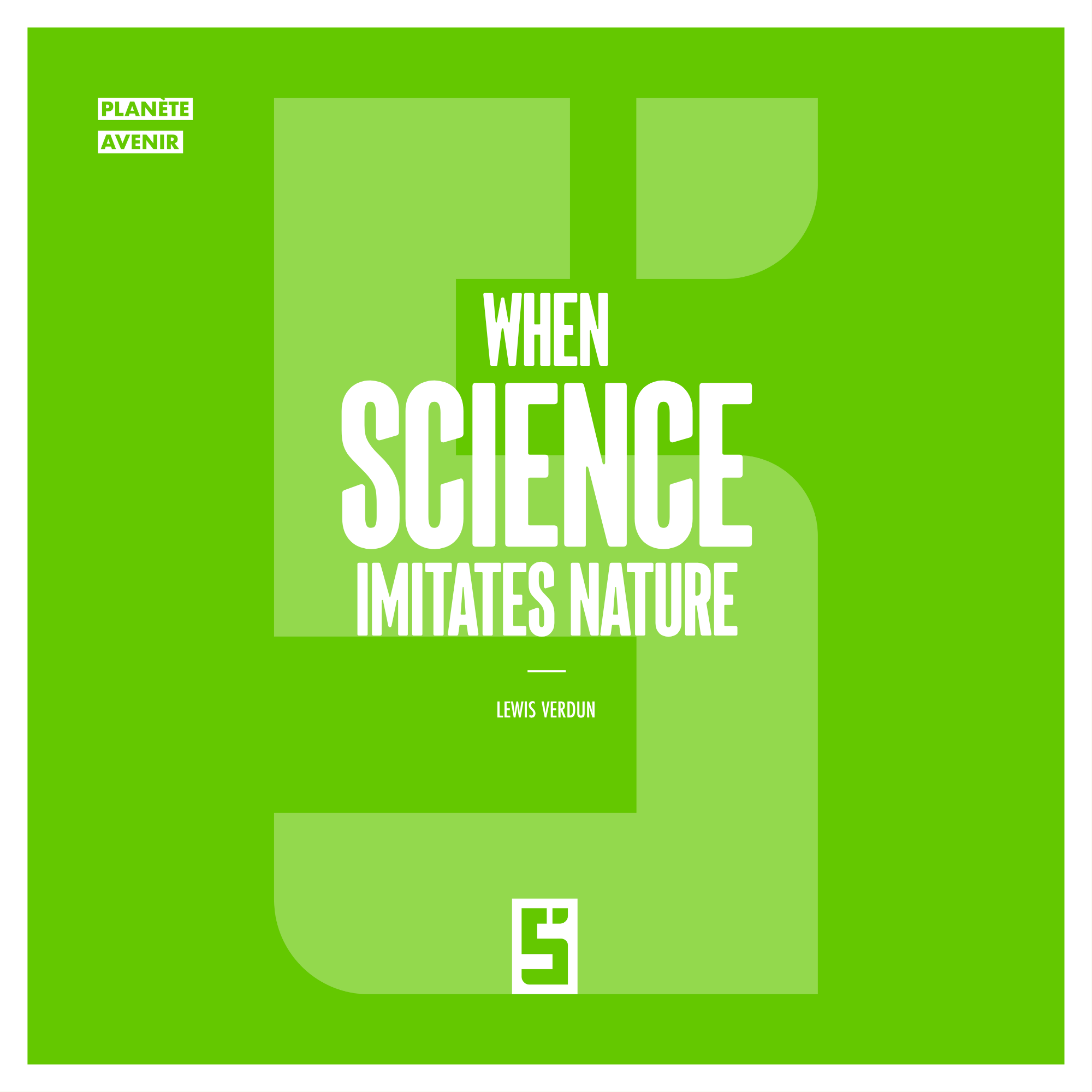
To explore this approach further and discover how scientists transform natural mechanisms into practical innovations, read When Science Imitates Nature by Léwis Verdun, available from FIVE MINUTES.
Discover this book today and learn to see nature as a remarkable laboratory of innovation for building a more sustainable future.