


 Français
 We check our phones when we wake up, reply to messages throughout the day, work in front of multiple screens, and sometimes end the evening scrolling through social media. Digital technology has become part of almost every moment of our daily lives. It allows us to communicate, work remotely, access services, stay informed, and entertain ourselves with an ease that was once unimaginable.
However, this transformation raises an increasingly important question: how can we achieve genuine digital balance without giving up the benefits of technology?
The issue goes far beyond simple screen time. Being connected for several hours to work, learn, or communicate with loved ones does not necessarily have the same consequences as being constantly exposed to notifications and automatic checking. The challenge, therefore, is not so much to eliminate screens as it is to regain control over the place they occupy in our daily lives.
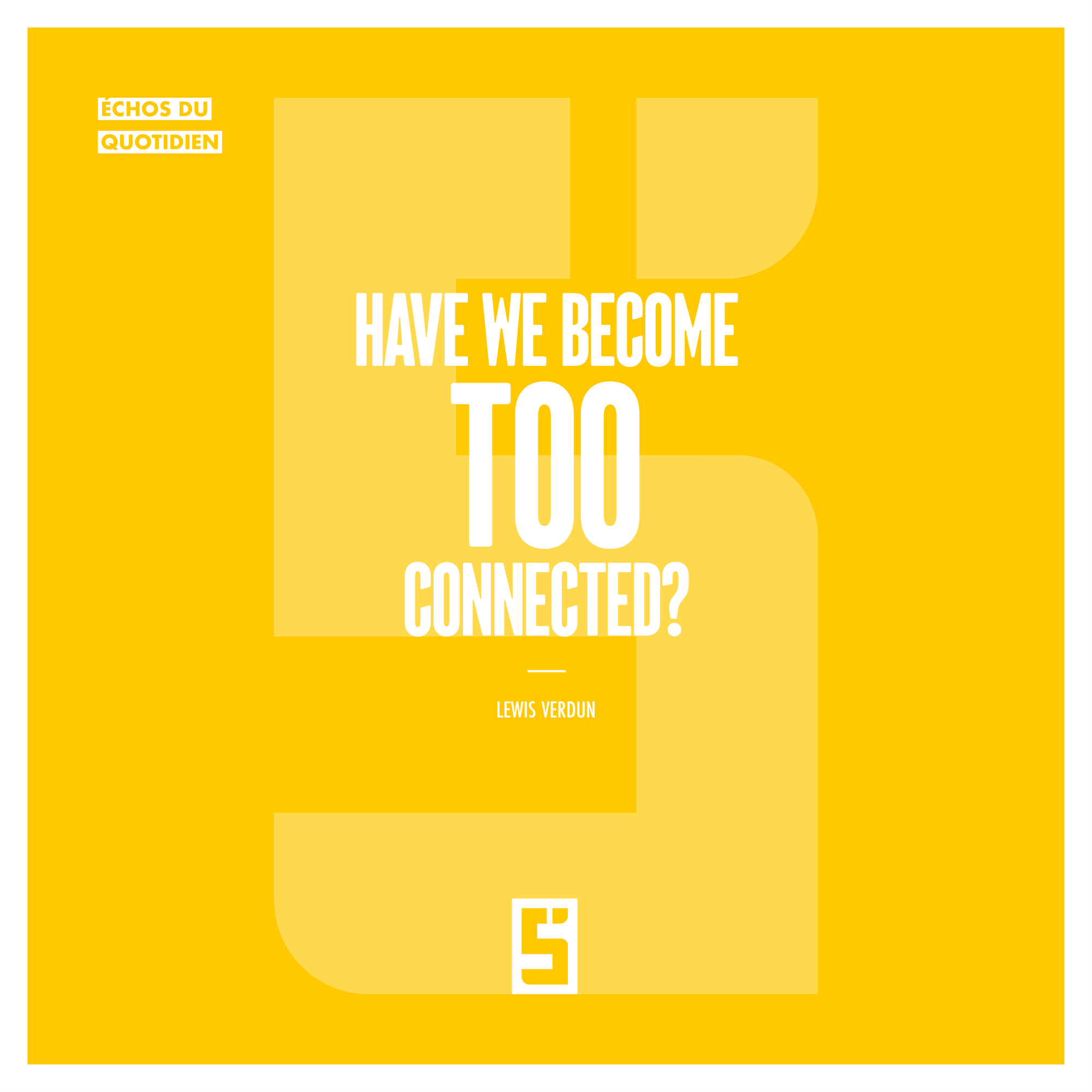
This reflection directly echoes the ideas explored by Léwis Verdun in Have We Become Too Connected?, published by Five Minutes in the ÉCHOS DU QUOTIDIEN collection. Through the major transformations brought about by constant connectivity, the book invites us to examine our relationship with technology from a more thoughtful perspective.
Hyperconnectivity is changing our relationship with time and attention
The smartphone has erased many of the boundaries that once structured our days. Personal communications can now follow us into the workplace, while professional demands can enter our homes at any hour.
This constant availability is convenient. It allows us to solve a problem quickly, obtain information within seconds, or stay in touch with someone on the other side of the world. But it also encourages the fragmentation of our attention.
A notification appears. We look at the screen. A message leads us to an app, then to another piece of information. A few minutes later, we may have forgotten what we were doing in the first place.
The problem, therefore, is not only the amount of time spent in front of a screen. It also concerns how frequently our attention is interrupted.
Hyperconnectivity can create a form of default availability: we gradually become accustomed to being reachable everywhere and at any time. In the professional world, this phenomenon has become particularly visible with the rise of remote work and collaborative tools.
These technologies offer considerable flexibility. They can reduce commuting and make collaboration easier. Yet when boundaries become blurred, the working day can also extend into periods that would normally be reserved for rest.
It is precisely in response to this type of change that the concept of the right to disconnect has gained importance: using digital tools without assuming that their existence requires us to be permanently available.
Finding balance therefore begins with a simple question: do we control when we connect, or are our devices gradually making that decision for us?
Screen time tells only part of the story
The screen time indicators available on smartphones can sometimes come as a surprise. Several hours of daily use may immediately seem excessive. Yet the raw figure needs to be interpreted.
An hour spent in a professional video conference does not serve the same purpose as an hour spent mindlessly scrolling through a news feed. Reading a digital book, taking a course, talking to a loved one, or completing an administrative task are also very different activities.
To build a healthier digital balance, it is therefore more relevant to consider the quality of our usage rather than focusing solely on reducing a number.
In particular, we can distinguish between intentional and reflexive use.
In the first case, we deliberately open an application to accomplish something: write to someone, look up specific information, work, learn, or consciously entertain ourselves.
In the second case, we reach for our phones almost automatically, sometimes without even knowing what we intended to do.
This distinction is essential. Digital disconnection does not necessarily mean removing technology from our lives. It can simply mean having greater control over when, why, and how we use it.
This reflection also concerns mental health and sleep. When screens accompany every moment of the day, it becomes important to observe their influence on rest, concentration, and our ability to be fully present with others.
The goal, therefore, is not necessarily to count every minute spent in front of a screen, but to understand which digital habits genuinely improve our daily lives and which ones deserve to be reconsidered.
Being less connected is not necessarily the solution
It would be tempting to conclude that the best response to hyperconnectivity is simply to use the Internet less. The reality is far more complex.
Digital connectivity has become a way to access employment, education, administrative services, healthcare, payment methods, and information. Telehealth can make certain consultations more accessible. Remote work can create new professional opportunities. Online services can simplify procedures that were once long and costly.
Connectivity is therefore also a tool for inclusion.
This dimension is all the more important because access to the Internet remains highly unequal. The international data discussed in Have We Become Too Connected? shows that a large majority of the world’s population is now online, while billions of people still remain excluded from this transformation.
Differences between regions, income levels, urban and rural populations, as well as between women and men, remind us that the digital question has two sides.
Some people are trying to protect themselves from an omnipresent connection. Others are still trying to gain access to a reliable and affordable connection.
Digital balance therefore cannot be reduced to a universal instruction to spend less time online. Instead, it means building a relationship with digital technology that is adapted to each person’s needs while maintaining access to the social and economic benefits it provides.
Regaining digital balance in everyday life
Changing our relationship with screens does not necessarily require a dramatic break. A few simple rules can already help transform automatic connectivity into more intentional use.
In the morning, waiting a few minutes before checking notifications can help us begin the day without immediately being confronted with external demands.
While working, disabling non-essential alerts helps preserve periods of concentration. It can also be useful to group message checking into specific periods rather than responding to every notification as soon as it appears.
Mealtimes also provide a simple opportunity to create some distance from screens. Keeping the phone away from the table encourages conversation and allows us to pay more attention to the people around us.
At the end of the day, setting a time after which professional communications are no longer checked can help establish a clearer boundary between work and personal life. This habit directly reflects the principle of the right to disconnect.
Before going to bed, keeping the smartphone at a distance can also create a clearer transition toward rest.
Another approach is to carry out a small personal audit over a few days. Rather than looking only at the total number of hours spent in front of screens, we can ask ourselves:
- Which applications are genuinely useful in my daily life?
- Which notifications truly require my immediate attention?
- At what times do I check my phone without a specific purpose?
- Which digital habits interfere with my sleep, work, or social relationships?
The answers often make it possible to identify a few very concrete changes.
These may include turning off promotional notifications, removing certain applications from the home screen, putting the phone on silent during an important activity, or defining periods during which professional messages are no longer checked.
The approach can also be collective. Within a family, everyone can agree to keep phones away during certain meals. In a company, teams can clarify the hours during which a response is genuinely expected. Among friends, it is also possible to prioritize certain moments when phones are put aside.
These habits have one thing in common: they do not reject technology. They simply reintroduce boundaries.
Toward technology that is chosen rather than endured
The issue of hyperconnectivity ultimately reveals a paradox of our time. Digital technologies were designed to make many aspects of our lives easier, yet their omnipresence can sometimes leave us feeling as though we lack time, calm, or attention.
The answer probably lies neither in permanent connectivity nor in complete disconnection.
Sustainable digital balance depends more on our ability to distinguish between the moments when technology genuinely serves us and those when it occupies our attention automatically.
This also means moving beyond an exclusively individual perspective. Our relationship with screens depends on how work is organized, how platforms are designed, access to digital infrastructure, social habits, and inequalities in Internet access.
The right to disconnect, education about digital practices, and inclusion policies are therefore all part of the same reflection: how can we make digital technology a tool that serves people rather than an additional constraint?
Ultimately, our screens are neither enemies nor a universal solution. They are tools whose impact depends largely on the place we give them. Observing our automatic behaviors, protecting our attention, preserving periods of rest, and consciously choosing how we use technology are already practical ways to develop a more balanced relationship with the digital world.
This is precisely the reflection that Léwis Verdun develops further in Have We Become Too Connected?. Drawing on international data, scientific research, and recent surveys, this short book examines the digital divide, remote work, telehealth, the effects of excessive screen exposure, social relationships, and initiatives that encourage disconnection.
An accessible read for gaining perspective on a phenomenon that now affects a large part of our daily lives and, above all, for reflecting on the place we truly want to give digital technology in our lives.
Want to rethink your relationship with screens? Discover Have We Become Too Connected? by Léwis Verdun now on FIVE MINUTES.