



 Français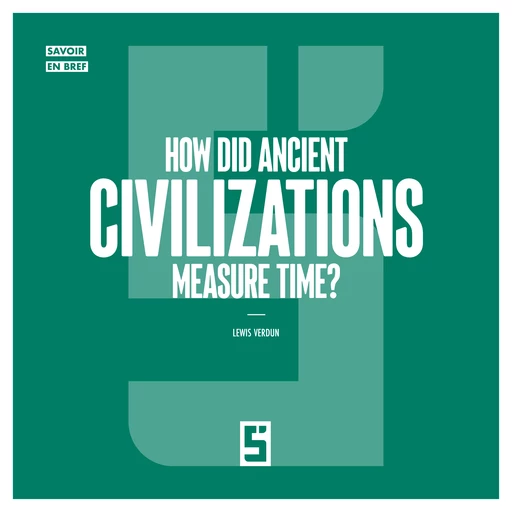
How Did Ancient Civilizations Measure Time ?
eBook [ePub]
Résumé
Ancient civilizations did not perceive time the way we do. In How Did Ancient Civilizations Measure Time ?, you will discover how the Sumerians chose base sixty to divide the day, how the Egyptians aligned their calendar with the star Sirius, and how the Maya synchronised cycles of 260, 365 and 819 days to predict planetary movements. The book explores sundials, clepsydras, incense clocks, astrolabes and the Antikythera mechanism–so many inventions that illustrate the creativity of peoples faced with the race of the stars and seasons.
Through a concise analysis inspired by the Harvard Business Review, this book highlights the influence of numerical systems (sexagesimal) and calendar reforms (Julian, Gregorian) on our daily lives. It also shows how infinitesimally small or gigantic units of time, like the Indian yugas, reflect cosmological visions.
This short volume from the Collection : SAVOIR EN BREF published by Maison d’édition : Five Minutes offers a fascinating journey through the universal history of time. It emphasises that, despite the precision of atomic clocks, we remain dependent on natural cycles. Dive into this book to understand how humans learned to “domesticate” time and why these ancient inventions continue to guide our calendars, rituals and modern technologies.
Through a concise analysis inspired by the Harvard Business Review, this book highlights the influence of numerical systems (sexagesimal) and calendar reforms (Julian, Gregorian) on our daily lives. It also shows how infinitesimally small or gigantic units of time, like the Indian yugas, reflect cosmological visions.
This short volume from the Collection : SAVOIR EN BREF published by Maison d’édition : Five Minutes offers a fascinating journey through the universal history of time. It emphasises that, despite the precision of atomic clocks, we remain dependent on natural cycles. Dive into this book to understand how humans learned to “domesticate” time and why these ancient inventions continue to guide our calendars, rituals and modern technologies.
Auteur
-
Léwis Verdun (auteur)
Léwis Verdun est un auteur contemporain âgé d'une quarantaine d'années, reconnu pour ses capacités à rendre accessibles des sujets variés et complexes. Passionné par la transmission claire et concise du savoir, Léwis bénéficie d'un parcours riche et diversifié dans de nombreux domaines. Tout au long de sa carrière, il a su développer une méthode efficace permettant d’aborder de manière simple et captivante des concepts parfois compliqués. Aujourd'hui, au sein de la maison d'édition FIVE MINUTES, Léwis met à profit son savoir-faire éditorial et son expertise pédagogique, tout en s’aidant des outils les plus avancés en intelligence artificielle pour assister son processus créatif. Grâce à cette approche hybride et novatrice, il offre aux lecteurs des contenus pertinents, enrichissants et adaptés au rythme de vie contemporain.
Avis
Caractéristiques
Éditeur : Five Minutes Éditions
Collection : Savoir en Bref
Publication : 8 avril 2026
Intérieur : Noir & blanc
Support(s) : eBook [ePub]
Contenu(s) : ePub
Protection(s) : Marquage social (ePub)
Taille(s) : 153 ko (ePub)
Langue(s) : Espagnol
Code(s) CLIL : 3044, 3143, 3161, 3315, 3645, 3836, 3144, 3162, 3163
EAN13 eBook [ePub] : 9791043413322